Why your bitcoin tip jar needs preset amounts
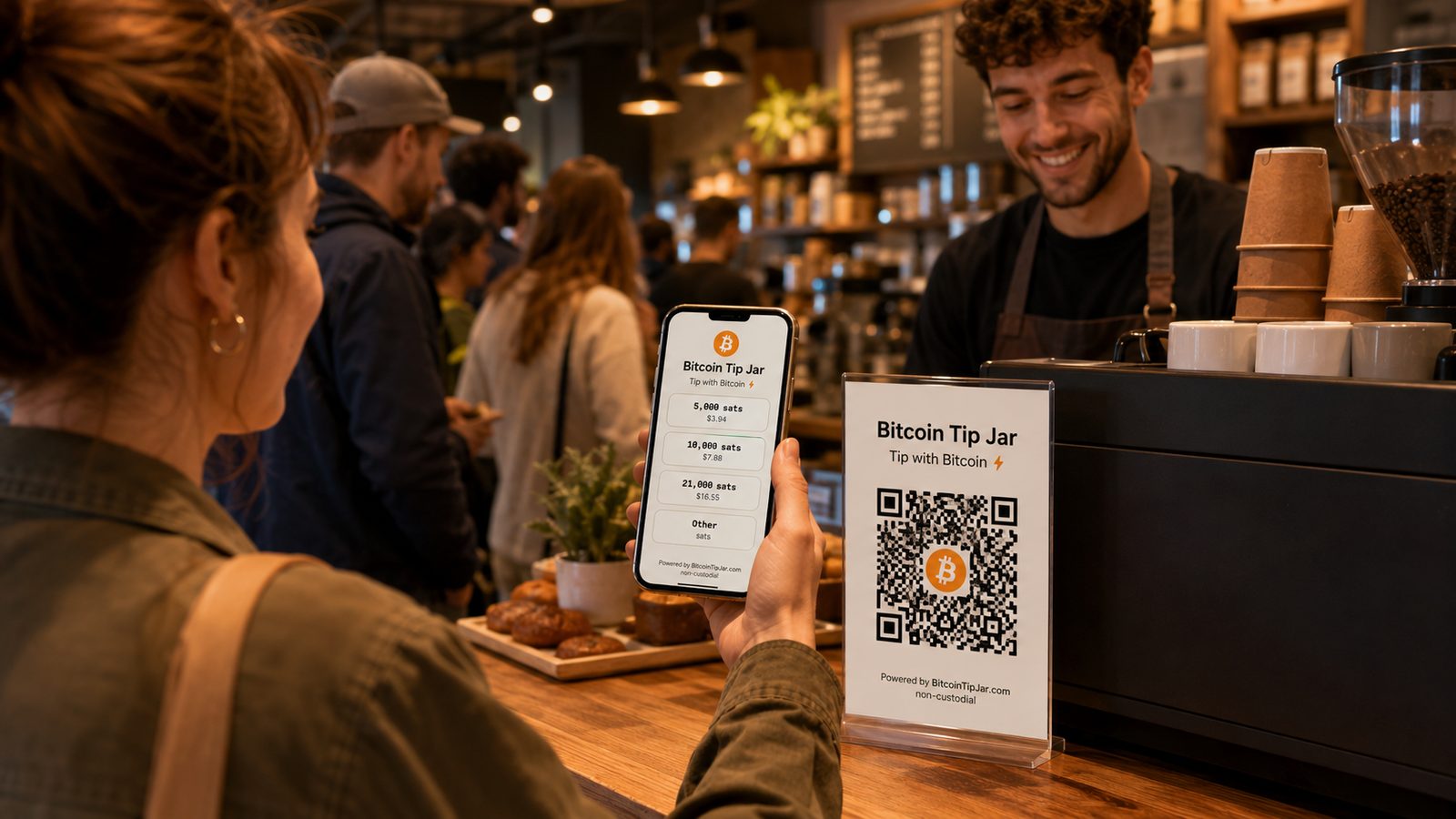
It is ten past eight on a Tuesday and the queue is out the door. A woman in a cycling jacket pays for her flat white and, while she waits for it, notices the sign by the till. Tips in bitcoin. A warm orange glow comes over her. These are her people! A coffee with a dash of freedom on the side... Why not.
She opens her wallet, points the camera at the QR code, and the wallet does exactly what it was built to do. It opens a payment screen with an amount field and a cursor blinking in it.
Now she has to think. She wants to leave about two dollars. How many sats is two dollars this morning? She has a feeling it was somewhere in the low thousands the last time she checked, but that was a while ago and the price has moved. The barista has already turned to the next order. The man behind her has his card out. She types 1,000, deletes it, types 500, decides that looks stingy, and after a few more seconds she puts the phone in her pocket and picks up her coffee.
The jar never knew she was there.
Run it again with one change. She scans the same code, and instead of an empty box she sees four tiles, each with the dollar value under it. She picks one, and her wallet handles the rest. A moment later the page on her phone says Paid. The whole thing took about as long as tapping her card for the coffee. She says thanks, the barista says thanks, and the queue moves.
That is the entire difference between a bitcoin tip jar and a wallet QR code stuck to the till. They use the same wallet, move the same sats and take the same few seconds. One of them shows the customer what a tip looks like, and the other one asks her to work it out on her own while people wait behind her.
The empty box is the problem
A bare Lightning address is a fine way to receive money. It is a poor way to ask for it, because it puts the whole decision on the person paying. Nothing on that wallet screen tells them what a normal tip is. They have to invent a number, in a unit they do not think in, in the ten seconds before someone else needs the counter.
People handle that in one of three ways. They type something small and safe, they guess and overshoot, or they give up. The third one happens far more than anyone likes to admit, and you never see it, because a tip that was never sent leaves no trace. From behind the counter the jar just looks quiet.
Card terminals solved this years ago. Nobody types a tip into an empty box on a card machine. They get three or four buttons and a way to enter their own number, and they tap one.
What the research says about suggested amounts
The clearest evidence comes from New York taxis. When the city put card terminals in the back of cabs, the screens offered passengers a short menu of suggested tips. Two economists, Kareem Haggag and Giovanni Paci, studied more than 13 million rides and compared two competing menus. One suggested 15, 20 or 25 percent and the other suggested 20, 25 or 30 percent. Roughly three quarters of passengers tapped one of the suggested buttons rather than entering their own amount, and the higher menu lifted the average tip by more than ten percent at the point where the two menus diverged.
The same study found the limit. Passengers shown the higher menu were over 50 percent more likely to leave no tip at all. The suggestions pulled most people up and pushed a minority out entirely.
Café owners saw the same thing when tablets with tip buttons arrived. The owner of a frozen yoghurt chain told Today that tips rose about 30 percent after switching to a tablet with suggested amounts. A New York café found that when it moved its buttons from 10, 15 and 18 percent up to a range that started at 15, more customers chose no tip, so it moved them back down.
That is the whole playbook in two lines. Suggest amounts, because most people will take one. Keep them reasonable, because the people who feel pushed will leave nothing.
Why the box is worse with bitcoin
With a card, the empty box problem is mild, because everyone has a rough sense of what 15 percent of their bill comes to. With bitcoin, the box asks for a number in sats, and almost nobody carries a feel for sats in their head. Even people who hold bitcoin and like it would rather not do currency conversion at a café counter.
Preset amounts take that job off the customer. They see four tiles with the dollar value under each one, they tap the one that feels right, and their wallet handles the rest. A decision that used to take fifteen seconds and a mental sum now takes one tap, and the tips that used to die in the pocket get sent.
How to choose your four amounts
Every jar on bitcointipjar.com starts with four preset amounts and an Other tile where people can type their own number. You choose which amounts are switched on from a short list, and if your jar has a name (bitcointipjar.com/yourname) you can change them whenever you like and the printed QR code keeps working.
A few rules follow from the research above and from watching real jars.
Anchor the ladder to what you sell. The smallest tile should feel like loose change next to your cheapest item, and the largest should feel like a generous round-up on your most expensive one. A busker and a barber are asking at very different moments, and their amounts should not look the same.
Set them a little above what people would pick on their own, and no higher. The taxi study is clear that a modest nudge lifts the average and an aggressive one drives people to zero. If you are unsure, start lower and move up once you have a few weeks of tips to look at.
Expect the middle to do the work. When people are offered a short ladder, most of them avoid both ends. The second and third tiles will collect most of your tips, so put the amount you would be happy with in one of those slots.
Keep the Other tile on. A few people dislike being told what to leave, and some of them are your most generous tippers. Give them the box. It costs you nothing, and it removes the only reason a preset menu ever annoys anyone.
Check the conversion now and then. Because the amounts are in sats, their value in dollars drifts with the bitcoin price. If the price moves a long way, your smallest tile can quietly turn into a bigger ask than you meant it to be. Have a look every month or so and shift the ladder if it needs it.
The same jar on three counters
A café keeps the ladder low and runs it from a small coin up to about the price of a coffee. Most customers tap the second tile. Now and then someone who just got paid in sats taps the top one.
A barber puts the same jar on the mirror. The ladder starts higher, because the service costs more, and the top tile is roughly what a good cash tip on a haircut used to be.
A market stall keeps it short and modest, because the customer is already paying for a jar of honey and the tip is just a thank-you.
None of them had to explain sats to anyone. The customer picked a tile.
Setting it up
You paste your Lightning address, choose your amounts, and you have a tip page and a QR code. Print the poster or the table tent, put it where people pay, and you are done. Tips go straight to your wallet. We never hold them, there is no account to create and nothing to pay.
If you already have a bare QR code on the counter, this is a ten minute change, and it is the one most likely to change what the jar actually earns. The woman in the cycling jacket comes in most mornings. It would be nice if the jar knew.
Sources: Kareem Haggag and Giovanni Paci, "Default Tips", American Economic Journal: Applied Economics, July 2014, https://www.aeaweb.org/articles?id=10.1257/app.6.3.1 (full paper: http://www.kareemhaggag.com/f/Default_Tips.pdf). "Guilt tipping: Are Square, mobile payments making us tip everyone?", Today, https://www.today.com/money/guilt-tipping-are-square-mobile-payments-making-us-tip-everyone-t126151